
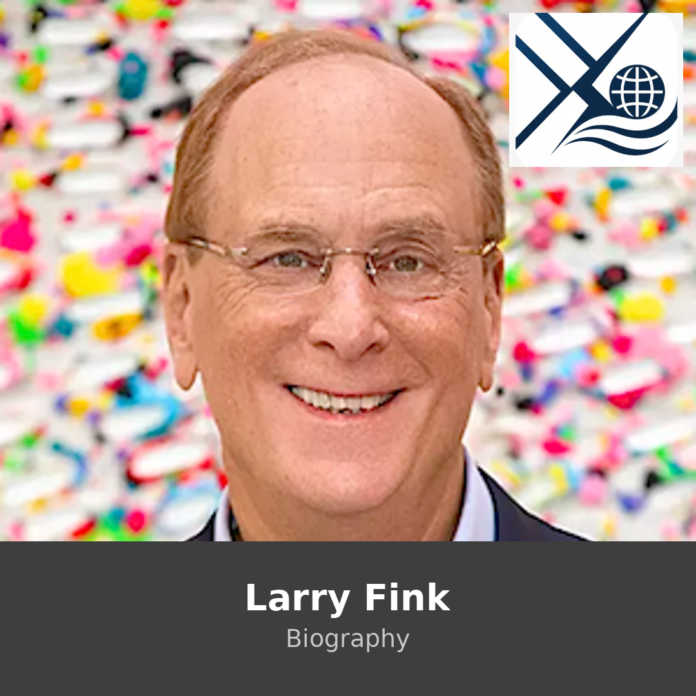

The name Larry Fink tends to surface when markets move and when politics tries to follow. In mid-January, the renewed attention had a clear trigger: BlackRock reported record assets under management after a strong quarter, and the scale alone forced the conversation back onto the firm’s leadership.
But the broader reason Larry Fink is being discussed again is more structural. His tenure sits at the crossing of indexing’s rise, the expansion of ETFs, and a new push by big asset managers into private credit and infrastructure. It has also sat inside a louder argument about what power looks like when it is exercised through ownership rather than elected office.
Larry Fink has spent years turning BlackRock into an operator that is not just a fund manager, but a financial utility for institutions that want scale, risk systems, and global distribution. Those choices have made him prominent in calm periods and unavoidable in turbulent ones. The coverage is rarely sentimental. It is usually about leverage, access, and whether any single executive should have this much influence over how capital is allocated.
Personal and Family Profile
Larry Fink’s personal life is known in outline and guarded in practice. That balance has been consistent across his public career: enough disclosed to satisfy standard biography, little offered that would create a durable tabloid storyline. For a figure whose public footprint is so large, the private footprint is comparatively contained.
He was born in 1952 and grew up in the Los Angeles area, later studying at UCLA. Public biographies commonly describe a family background rooted in small business and education, with a tone that fits how Larry Fink presents himself now: practical, competitive, skeptical of easy narratives.
In public settings, Larry Fink’s family is typically referenced as context rather than content. That matters, because his influence attracts speculation. The record that can be responsibly reported is the record he and credible biographical sources have made plain, without turning relatives into collateral.
Spouse or Long-Term Partner
Public biographies report that Larry Fink married Lori Weider in 1974, a long-term partnership that has been described as stable and longstanding rather than publicly performative.
What stands out is how little the marriage has been positioned as part of the Larry Fink brand. He has not built a public identity around domestic access, and he rarely leans on family narrative as a credibility prop.
That restraint has functioned as a boundary. It keeps Larry Fink in the category of executive power, not celebrity lifestyle, even when public curiosity pushes in the other direction.
Children and Family Life
Public sources consistently report that Larry Fink has three children. The details most often stop there in serious coverage, and there are practical reasons for that: family members who are not public officials or entertainment figures do not benefit from exposure.
When Larry Fink’s family life appears in mainstream reporting, it tends to be in passing—usually as a reminder that his career has unfolded alongside a private home life that has remained comparatively insulated from the public machine.
That limited visibility is not a gap to be “filled.” It is, in effect, part of the record: a deliberate absence of access.
Friends and Professional Circle
Larry Fink’s professional circle is easier to observe than his private friendships because the work is relational. BlackRock’s business sits on institutional trust—pension funds, insurers, sovereign wealth funds, central banks, and corporate boards.
His closest operational circle has historically included senior lieutenants who can execute across markets, risk, technology, and distribution. Outside BlackRock, his professional proximity to policymakers and business leaders is often inferred from meetings, conferences, and the routine diplomacy of large capital pools.
In practical terms, Larry Fink’s “circle” is less a social list and more an ecosystem: the people who decide how money moves, and who treat BlackRock as infrastructure.
Parents and Early Family Background
Public biographies commonly describe Larry Fink as the child of a small-business owner and an educator, raised in a middle-class Jewish family in California. Those details are frequently referenced because they map cleanly onto the persona: disciplined, numbers-first, comfortable with institutions but not dependent on inherited institutional status.
His education is also consistently noted: a BA at UCLA in 1974 and an MBA earned soon after. Even in finance, where credentials are abundant, the way Larry Fink’s biography is framed suggests that the deeper credential was the market itself.
The early background is often used, implicitly, to explain why Larry Fink talks about risk the way he does—less as theory, more as memory.
Relationship History
Larry Fink’s relationship history is not publicly chronicled as a sequence of high-profile partnerships. The dominant biographical fact is the long marriage, which limits the space for speculative timelines.
That does not mean gossip has not existed. It means it has not become the organizing principle of his profile. The more durable public narrative remains career, not romance.
For an executive whose influence draws conspiracy-style attention at times, the absence of a public relationship carousel also removes one common lever of reputational drama.
What is Larry Fink’s full name?
Public biographies identify Larry Fink as Laurence Douglas Fink. He is widely known professionally as Larry Fink, a shorthand that has followed him through decades of public leadership. The use of “Larry” is consistent across mainstream coverage and official corporate material tied to BlackRock.
Is Larry Fink married?
Public biographies describe Larry Fink as married, with a long-running marriage that is treated as established fact rather than rumor. He has not turned his relationship into a public storyline. The marriage is typically referenced briefly, then the coverage returns to his professional role.
Who is Larry Fink’s wife?
Biographical sources commonly name Larry Fink’s wife as Lori Weider. The relationship is frequently described as longstanding, dating back to early adulthood. Larry Fink does not appear to use family visibility as a public-relations strategy, so references remain limited and non-sensational.
Does Larry Fink have children?
Yes, public biographies commonly report that Larry Fink has three children. Beyond that headline fact, credible reporting usually avoids detailed family profiling. That restraint reflects a standard boundary: relatives are not automatically public figures simply because Larry Fink is highly visible.
Where did Larry Fink grow up?
Public profiles describe Larry Fink as growing up in the Los Angeles area, including Van Nuys in California. The background is often highlighted to frame a middle-class origin story. It is typically used as context for his worldview, not as a source of personal drama.
What is known about Larry Fink’s parents?
Biographical accounts commonly describe Larry Fink’s father as a shoe-store owner and his mother as an English professor. These details appear repeatedly in standard profiles. They are cited not for sentiment, but because they support the broader narrative of upward mobility through education and work.
Does Larry Fink keep his personal life private?
Compared with many high-profile business leaders, Larry Fink’s personal life is relatively restrained in public. Basic family facts are widely known, but daily domestic details are not. The public profile is built around institutions, markets, and policy debates, not lifestyle disclosure.
Who are Larry Fink’s closest friends?
Larry Fink’s private friendships are not comprehensively documented in credible public sources. What is visible is his professional network, shaped by clients, regulators, and global business leaders. In his case, the “inner circle” that matters publicly is operational and institutional rather than social.
Has Larry Fink publicly discussed family life?
Larry Fink has acknowledged family life in a limited, conventional way through biography and occasional remarks, but he does not consistently frame his leadership story through personal narrative. When he is quoted at length, the subject is typically markets, risk, and capital allocation rather than home life.
Why is Larry Fink’s relationship history not widely covered?
Because the public record does not present it as a recurring storyline. A long marriage reduces the churn that fuels celebrity-style coverage, and Larry Fink’s public role attracts attention that is primarily structural—finance, policy, corporate power. Where personal detail is not clearly established, serious profiles avoid invention.
Career Overview
Larry Fink’s career is often summarized as BlackRock’s rise, but that summary can hide the more specific story: he helped professionalize risk as a product, built distribution at scale, and made technology a parallel business line rather than an internal tool.
Official BlackRock material describes Larry Fink as Chairman and Chief Executive Officer, and notes that he and seven partners founded BlackRock in 1988. That founding date matters because it places Larry Fink at the start of modern institutional asset management’s consolidation era, before indexing became the default for huge flows.
In the decades since, Larry Fink’s influence has been amplified by two BlackRock features: the firm’s sheer size, and its positioning as a technology-and-risk provider as well as an investment manager. The argument around Larry Fink’s power is, in part, an argument about what happens when a firm becomes both steward and system.
Early Career and First Breakthrough
Larry Fink began on Wall Street in fixed income during the expansion of mortgage-backed securities. The early narrative is commonly told as technical skill paired with a hard lesson about risk, a lesson that later became central to how he speaks about markets.
The first breakthrough, in career terms, was not celebrity status. It was institutional credibility: becoming a figure who could build, manage, and sell complex exposure at scale inside large firms.
That period also set up Larry Fink’s later advantage. He did not only learn how to trade. He learned how institutions fail when they cannot measure what they own.
How the Career Started
The start of Larry Fink’s career is frequently framed through product innovation in bond markets and the early industrialization of structured finance. It was a period when speed and leverage could produce dramatic growth, and dramatic mistakes.
His later leadership style—obsessed with systems, measurement, and governance—reads as a response to that environment. The point is not mythology. It is continuity: the same questions about risk that defined early bond markets later defined BlackRock’s corporate identity.
When Larry Fink founded BlackRock, the differentiator was not a single fund. It was an operating model built around risk analytics and institutional trust.
Major Achievements and Milestones
Larry Fink’s signature milestone is building BlackRock into the world’s largest asset manager by assets under management, a scale that periodically resets records. In January 2026, BlackRock reported full-year 2025 results including roughly $14 trillion in assets under management.
Other milestones are structural: building iShares into a dominant ETF franchise, integrating acquisitions, and expanding the firm’s reach across regions and client types. The milestones are not only about growth; they are about distribution.
A parallel milestone is BlackRock’s technology footprint, including Aladdin, marketed as a platform that unifies the investment management process. Even critics of BlackRock concede that technology has become part of its competitive moat.
Career Challenges and Growth
Larry Fink’s challenges have increasingly been political. The firm’s size attracts scrutiny from both sides: accusations of being too supportive of environmental and social agendas, and accusations of retreating from them when the politics turn hostile.
Coverage of Larry Fink’s annual letters has highlighted a shift in messaging in recent years, with reduced emphasis on ESG language and a stronger focus on retirement, access, and private markets. That shift has been interpreted variously as pragmatism, brand management, or capitulation, depending on the audience.
There is also the operational challenge of scale. When BlackRock grows, it inherits complexity. Larry Fink’s growth story is inseparable from his ability to keep the institution coherent while it expands.
Current Work and Professional Direction
Larry Fink’s current direction, as described in both coverage and BlackRock’s own communications, emphasizes expanding beyond traditional index and active products into higher-fee private markets, while maintaining ETF leadership.
In his 2025 chairman’s letter, Larry Fink positioned expanded participation in capital markets and lowering barriers to investing as a central theme, linking that idea to BlackRock’s strategy and regional expansion. The message is consistent: widen the funnel, deepen the product shelf.
The professional direction is also defensive in a strategic sense. Private markets and data/technology can diversify revenue and reduce dependence on fee compression in traditional products. That is a business logic Larry Fink has leaned into publicly.
What is Larry Fink’s role at BlackRock?
Larry Fink is described by BlackRock as its Chairman and Chief Executive Officer. He is also described as a founder of the firm, which positions him as both architect and current operator. The role is not ceremonial; it is tied directly to strategy, messaging, and the firm’s long-term positioning.
When did Larry Fink found BlackRock?
BlackRock’s corporate leadership biography states that Larry Fink and seven partners founded BlackRock in 1988. That founding date is a cornerstone of his public narrative. It anchors his influence in institution-building rather than in a short-cycle trading story, which matters in how he is judged.
How did Larry Fink start his finance career?
Larry Fink started in fixed-income markets during an era when structured finance and mortgage products were expanding rapidly. Public profiles often frame the period as formative for his later focus on risk systems. The key theme is not a single job title, but the early exposure to how institutions price and misprice risk.
What are Larry Fink’s biggest business achievements?
His biggest achievement is building BlackRock into a global asset-management leader by scale, product breadth, and institutional reach. Another is the expansion of the ETF and indexing franchise that turned BlackRock into a core utility for many investors. A further achievement is the parallel build-out of technology offerings tied to investment workflows.
How large is BlackRock under Larry Fink?
BlackRock reported record assets under management around $14 trillion in its full-year 2025 reporting. That figure is frequently used as shorthand for the firm’s reach and the scale of Larry Fink’s leadership. The number matters because it implies influence across companies, countries, and retirement systems.
What is Aladdin and why is it linked to Larry Fink?
Aladdin is BlackRock’s technology platform used for investment management workflows, including data and risk analytics. It is linked to Larry Fink because the firm’s risk-and-technology identity is central to his leadership story. In public debate, Aladdin is often cited as evidence that BlackRock is more than an asset manager.
What controversies has Larry Fink faced?
The controversies tend to cluster around perceived political influence and ESG debates. Larry Fink has faced criticism from groups arguing BlackRock pushed sustainability too aggressively, and from others arguing the firm has since softened its stance. His annual letters have become a focal point because they are treated as strategic signals.
Has Larry Fink changed how he talks about ESG?
Recent coverage and analysis has noted that Larry Fink’s letters have reduced emphasis on ESG language, with greater focus on themes like retirement preparedness, private markets, and access to investing. Observers interpret this shift differently depending on political and market context. The change is widely discussed because it affects expectations.
What is Larry Fink focused on now?
Publicly, Larry Fink is focused on broadening participation in capital markets while expanding BlackRock’s private-markets and alternatives footprint. The strategy aims to diversify revenue and meet demand for infrastructure, private credit, and other less liquid assets. He also continues to emphasize scale, technology, and risk governance.
Is Larry Fink still influential beyond finance?
Yes, because BlackRock’s clients include major institutions and because his public messaging often touches economic policy themes such as retirement security, market structure, and protectionism. The influence is not legislative. It is agenda-setting: what topics get framed as “inevitable” in finance and what becomes mainstream debate.
Public Image and Social Impact
Larry Fink’s public image is unusually complicated for a finance executive because he is both a corporate operator and a public narrator of capitalism. Many CEOs avoid broad social language. Larry Fink has often leaned into it, then adjusted when the politics demanded a different posture.
Media representation tends to split into two storylines. One is the technocrat: Larry Fink as the CEO running a gigantic institution, measured in flows, fee rates, and acquisition strategy. The other is the symbol: Larry Fink as shorthand for concentrated financial power, sometimes described with language that implies shadow governance.
That second storyline can become overheated. Still, it exists because BlackRock’s ownership footprint touches almost every corner of public markets, and Larry Fink has often spoken as if capital allocation is a public mission. The attention is the predictable result of that combination.
In recent cycles, his annual letters have acted like a kind of state-of-the-market address, parsed not just by investors but by political actors. When Larry Fink warns about macro themes—protectionism, inequality, access to private markets—those warnings are treated as signals of where big finance wants to go next.
Media Representation and Press Coverage
Coverage of Larry Fink is typically triggered by three events: BlackRock earnings, major acquisitions, and the annual letter. When BlackRock hit record assets, the press treated it as both market story and power story.
The press also tends to personalize a structural reality. “Larry Fink” becomes a stand-in for the firm, even when decisions are made by committees and executed by teams. This personalization is useful for headlines. It can be misleading for governance.
Still, Larry Fink has participated in the personalization by making himself a narrator. His letters and interviews are written to land beyond a narrow investor audience.
Public Persona and Audience Perception
Larry Fink’s public persona is calibrated: measured, institutional, confident without flash. He is not a celebrity executive in the Silicon Valley sense. He is a finance statesman, which is a different style of authority.
Audience perception varies sharply by constituency. Institutional clients often read Larry Fink as stability and scale. Critics often read Larry Fink as a proxy for corporate overreach, particularly when BlackRock’s voting power becomes part of public argument.
The polarizing element is not personality. It is proximity to decisions that shape other people’s lives: pensions, housing finance, infrastructure build-out, and corporate strategy by proxy ownership.
Influence on Social and Cultural Conversations
Larry Fink has influenced how mainstream audiences talk about investing and retirement, largely because he frames finance as participation in growth rather than as elite sport. In his 2025 letter, he explicitly emphasized expanding access and lowering barriers, tying the idea to BlackRock’s platform and partnerships.
He has also influenced the ESG conversation by making it, for a period, central to CEO-to-CEO messaging—then by stepping back rhetorically when ESG became politically toxic language. The shift itself became a cultural signal: not necessarily a change in product shelf, but a change in what is safe to say out loud.
The broader influence is about legitimacy. When Larry Fink talks, the market listens because the firm is enormous. That listening creates a feedback loop.
Advocacy, Awareness, and Social Causes
Larry Fink’s public advocacy is better described as agenda-setting than cause campaigning. He frequently frames issues like retirement insecurity and market access as systemic problems that finance can partially solve, particularly through product design and distribution.
At the same time, he has increasingly emphasized pragmatism, especially where climate, energy transition, and political backlash intersect. Coverage of the annual letters has noted how language choices are now more cautious than in earlier cycles.
The social question around Larry Fink is not whether he supports a cause. It is whether a private asset manager should be positioned as a principal architect of public economic outcomes.
Reputation Management and Public Response
Larry Fink’s reputation management has been built on institutional tone and selective responsiveness. He does not typically trade in viral confrontation. When criticism intensifies, the firm tends to respond through policy statements, product framing, and messaging adjustments rather than personal sparring.
The most visible example is the evolution of how Larry Fink writes about ESG and corporate purpose. Observers have treated the change as reputational calculus: keep the business broad, reduce political heat, protect distribution.
Public response remains divided but durable. Larry Fink does not need to be loved to remain influential. He needs BlackRock to remain central. The record suggests it is.
Why is Larry Fink so frequently in the news?
Larry Fink is frequently in the news because BlackRock’s scale makes even routine financial reporting politically and culturally significant. Earnings, record assets, and major strategy shifts become wider stories. His annual letter is also treated as a signal event, pulling coverage beyond finance desks into mainstream discussion.
How do people describe Larry Fink’s power?
Supporters describe Larry Fink’s power as institutional leadership of a firm trusted by clients to manage capital at scale. Critics describe the power as concentrated influence over corporate governance and market structure. Both descriptions point to the same driver: BlackRock’s size. The debate is about whether influence is accountability-free.
Is Larry Fink controversial?
Larry Fink can be controversial because he sits at the intersection of finance and politics, particularly through debates about ESG, corporate voting, and market influence. His messaging shifts are scrutinized, and BlackRock’s choices are often read as political signals. The controversy is usually structural, not personal scandal.
How has the media framed Larry Fink’s annual letters?
The media often frames Larry Fink’s annual letters as strategy documents and public persuasion tools. Themes like retirement, access, protectionism, and private markets are treated as agenda-setting. The absence or reduction of certain language—especially ESG-related terms—has also become a story in itself because it signals a messaging pivot.
What social impact is linked to Larry Fink?
Larry Fink’s social impact is linked to how investing is normalized for large populations, including retirement savers, and to how corporate governance is influenced through institutional ownership. He has also shaped the public debate about whether finance should explicitly address social and environmental questions. The impact is indirect but broad.
Does Larry Fink influence government policy?
Larry Fink does not set policy the way elected officials do, but he can influence policy conversations because BlackRock is a major institutional actor and he speaks publicly about macro themes. When he warns about protectionism or promotes expanding market access, policymakers and stakeholders often treat it as pressure and positioning.
How do investors view Larry Fink?
Many institutional investors view Larry Fink as a steward of scale, risk systems, and global distribution, which are practical advantages. Others view his public messaging as a complicating factor, adding political risk to a financial relationship. The perception depends on whether the investor prioritizes stability, branding neutrality, or ideological alignment.
Why did Larry Fink reduce ESG language in public messaging?
Coverage of recent letters has highlighted reduced use of ESG terminology and related buzzwords, often interpreted as a response to politicization of the terms. The shift can be read as pragmatic: keep focus on core financial themes and protect broad client relationships. Whether products changed as much as language remains debated.
How does Larry Fink handle criticism?
Larry Fink tends to handle criticism through institutional messaging rather than personal confrontation. Changes in tone, emphasis, and framing in public letters are often treated as part of reputation management. The firm also relies on scale and client reliance as a stabilizer. The approach is to absorb controversy, not chase it.
What makes Larry Fink’s public persona distinctive?
His persona is distinctive because it blends CEO authority with a quasi-public narrative about capitalism’s purpose. Many asset-management leaders stay inside technical lanes. Larry Fink routinely connects strategy to societal outcomes—retirement security, access, inequality—then recalibrates when political pressure rises. That combination keeps him central to debate.
Lifestyle and Personal Interests
Reliable public detail about Larry Fink’s lifestyle is limited, and the absence is itself informative. Unlike entertainment figures, Larry Fink is not marketed through visible consumption. His public profile is built through institutional language and the mechanics of capital, not through curated leisure.
His daily life, to the extent it can be responsibly described, is shaped by the operating realities of a global asset manager: markets that never fully sleep, clients distributed across time zones, and a calendar that includes earnings cycles, investor meetings, government-facing dialogue, and internal governance.
Personal interests become visible mainly where they intersect with public institutions—education, philanthropy, and the ecosystem of boards and initiatives that surround elite finance. Even there, the record tends to focus on organizational affiliation rather than intimate routine.
The more important lifestyle point is not what Larry Fink does after work. It is that his work has become an identity with public consequences, and that identity limits how “private” any visible habit can remain. For a leader of BlackRock’s scale, even a neutral personal preference can be misread as signal.
Daily Routine and Personal Habits
A plausible description of Larry Fink’s routine is agenda density: early market review, client communication, internal strategy, regulatory sensitivity, and recurring crisis readiness. The CEO of an asset manager measured in trillions does not have many fully quiet days.
His public communications suggest a preference for structure and repetition. Annual letters, predictable quarterly reporting, and consistent strategic themes indicate an executive who treats narrative as part of governance.
The routine is also international. Larry Fink’s strategy messaging repeatedly references global engagement and regional market development, a reminder that leadership here is travel, diplomacy, and time-zone discipline.
Hobbies and Recreational Activities
There is no credible public record that supports a detailed list of Larry Fink’s hobbies in the way celebrity profiles sometimes provide. That limitation should be respected rather than improvised.
In the absence of hobby visibility, observers often treat work itself as the hobby—an unfair simplification, but one that reflects how institution-heavy leadership can dominate public perception.
If Larry Fink has recreational routines, they appear to be kept outside the public storyline. That choice reduces noise and keeps attention on BlackRock’s strategy rather than on lifestyle interpretation.
Health, Fitness, and Well-Being
Responsible reporting about health avoids speculation. Larry Fink’s continued high-intensity professional activity suggests functional capacity, but it does not justify personal medical inference.
Well-being, in his case, also has an institutional dimension. A leader in this role must project steadiness. The market reads mood and continuity as signals, and sudden withdrawal can generate narratives that outpace facts.
The safer, evidence-based observation is that Larry Fink maintains a public schedule consistent with active leadership, and BlackRock continues to communicate strategy with him as the firm’s primary narrator.
Travel, Leisure, and Personal Preferences
Larry Fink’s travel is most visible through strategy messaging and global client engagement rather than leisure display. The travel is framed as business diplomacy: meeting stakeholders, discussing capital market development, and supporting regional expansion.
Personal preferences, when visible, are usually expressed through institutional priorities: retirement outcomes, market access, and a preference for pragmatic framing over ideological slogans.
This is not a lifestyle built for admiration. It is a lifestyle built for operational continuity.
Interests Outside Professional Work
Larry Fink’s “outside” interests appear most reliably in education and civic-institution involvement, areas where finance leaders often formalize their influence. The public record tends to discuss these interests through programs, boards, and philanthropic initiatives rather than through intimate narrative.
He has also shown a sustained interest in shaping how people participate in markets—an interest that can be framed as business strategy, public mission, or both. It is difficult to separate the motives cleanly because the outcomes benefit BlackRock.
If there is a consistent personal interest visible across his messaging, it is control through systems: risk, data, access, measurement. That is not leisure. It is identity.
What is Larry Fink’s day-to-day life like?
Larry Fink’s day-to-day life is best understood as institutional management: overseeing strategy, engaging clients, responding to market shifts, and steering public messaging. The CEO role at BlackRock involves global time zones and continuous risk awareness. While private routine details are limited publicly, the professional cadence is visible through regular communications and reporting cycles.
Does Larry Fink have publicly known hobbies?
Credible public sources do not consistently document Larry Fink’s hobbies in detail. Unlike lifestyle-focused public figures, he is not typically profiled through recreation. That does not mean hobbies do not exist; it means they are not central to his public identity. Responsible biography avoids inventing specifics where the record is thin.
How does Larry Fink handle work-life balance?
Larry Fink does not publicly market a detailed work-life balance narrative. What can be observed is that his leadership role requires persistent engagement, especially during earnings and market stress periods. Any balance is likely managed privately, with limited public disclosure. The visible emphasis is operational continuity rather than lifestyle storytelling.
Is Larry Fink known for fitness or health routines?
There is no widely established public record of Larry Fink promoting a specific fitness regimen. Health details are private and should not be speculated about. The most grounded observation is that he continues to operate in a demanding leadership role. Beyond that, responsible reporting stays cautious.
Does Larry Fink travel frequently?
Yes, frequent travel is commonly implied by the global nature of his role and by his public discussion of meeting stakeholders across regions. His travel is usually framed as business engagement rather than leisure. The CEO of a firm with worldwide clients and operations typically maintains an international schedule, even when details are not publicized.
What personal preferences does Larry Fink share publicly?
Larry Fink’s public preferences appear through themes: expanding access to investing, emphasizing retirement security, and using pragmatic language on contested topics. He does not usually share consumer-style preferences or lifestyle tastes. His public voice is shaped to sound institutional. What he chooses to emphasize is usually strategic rather than personal.
Does Larry Fink live a private lifestyle?
Compared with many high-profile figures, Larry Fink’s lifestyle is not heavily documented through curated media exposure. He is visible through his role and messaging, not through leisure content. That relative privacy limits definitive claims about daily habits. The public record supports a contained personal footprint and an expansive professional one.
How does Larry Fink manage stress?
Stress management is not something Larry Fink documents publicly in a detailed way. The more reliable evidence is structural: institutions like BlackRock rely on systems, delegation, and process to reduce reliance on individual emotion. His leadership style emphasizes risk frameworks and repeatable governance. That can function as a form of organizational stress control.
What interests does Larry Fink have outside finance?
Publicly, Larry Fink’s outside interests are most visible through education and civic-institution involvement rather than entertainment or lifestyle branding. The record frequently treats these as formal affiliations, not personal hobbies. He is also publicly engaged in conversations about retirement and market participation, which straddle public purpose and corporate strategy.
Why is there limited lifestyle information about Larry Fink?
Because the public demand around Larry Fink is primarily about power, markets, and policy, and because he has not made private life a major part of his public identity. Executives at this level often keep lifestyle details sparse to reduce misinterpretation and security risk. The record reflects that boundary.
Conclusion
Larry Fink’s biography is, at its core, a story about the modernization of finance through scale, systems, and narrative. He helped build BlackRock into an institution that now measures itself in trillions and uses technology as both operating backbone and competitive advantage. The firm’s record-setting size in recent reporting keeps the leadership question active: what does stewardship mean when stewardship itself becomes a kind of infrastructure.
The public record resolves the broad facts with clarity. Larry Fink is BlackRock’s Chairman and CEO and a founder of the firm. His personal life is described in standard biographical terms—marriage, family, education—without being turned into public spectacle.
What remains unresolved, and likely always will, is the interpretation. Some will continue to frame Larry Fink as a disciplined builder of tools that help savers and institutions function. Others will continue to frame Larry Fink as the human face of concentrated capital power, with influence that exceeds public accountability. Those are not reconciled narratives.
The next chapter is unlikely to hinge on personality. It will hinge on strategy: how far private markets expansion goes, how BlackRock manages political risk around governance themes, and whether Larry Fink can keep the institution central without becoming the story in a way that constrains it.