
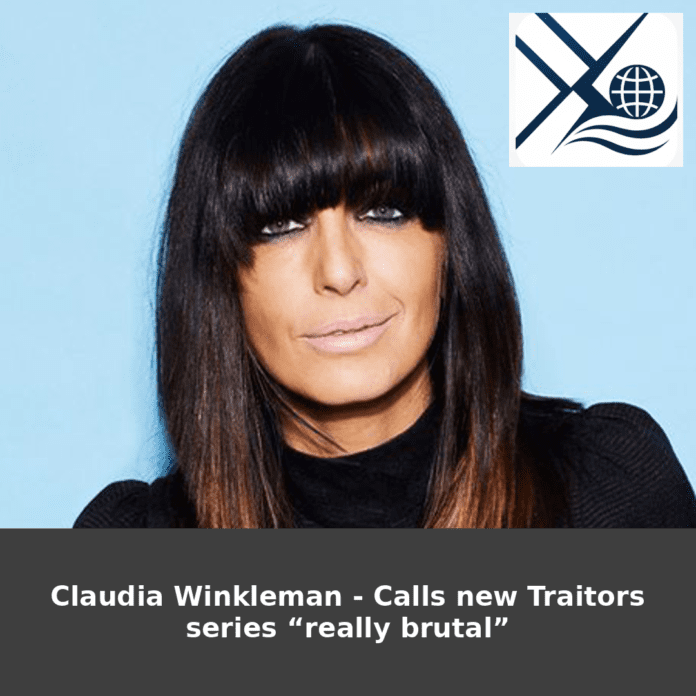

Claudia Winkleman is again in the middle of the conversation around The Traitors, and this time the language is sharper. In recent promotional talk around the returning format, she has described the new Traitors series as “really brutal,” a phrase that has landed because it fits what viewers already suspect: the show is no longer trading solely on novelty, but on escalation.
The Traitors has always depended on pressure—friendship tested in public, trust performed as strategy, everyday politeness weaponised into misdirection. But the attention around Claudia Winkleman’s “really brutal” description has added a specific edge to the run-up. It suggests a series that leans harder into the emotional costs, not just the gameplay mechanics.
Claudia Winkleman’s presence is part of why that framing carries. She is not a presenter who sells spectacle with volume. She tends to underplay, to observe, to let pauses do the work. When she signals that a series feels harsher, it reads as an editorial note, not an advert. And it raises the question the show relies on more than any twist: how far can it go and still feel like entertainment rather than endurance?
Claudia Winkleman and the “really brutal” framing around The Traitors
When Claudia Winkleman calls a Traitors series “really brutal,” the phrasing does two things at once. It sets expectation for viewers who want the show to feel consequential. It also positions the presenter as a witness, not a ringmaster—someone seeing the same discomfort the audience will later watch from the safety of a sofa.
The Traitors format is built to create suspicion quickly. It isolates people, strips away ordinary cues, then asks them to interpret behaviour as evidence. A glance becomes a signal. Silence becomes a confession. The mechanics are simple enough to understand within minutes, which is why the emotional fallout ends up feeling bigger than the rules themselves. The more familiar the audience becomes with the structure, the more they watch for stress rather than strategy.
Claudia Winkleman’s role sits in that tension. She is both guide and boundary-setter. She arrives with the authority of a host who has spent years steering live television without appearing to steer it. Yet the show asks her to be cooler than she is on other programmes, to let uncertainty hang in the air, to keep the atmosphere taut.
That’s where “really brutal” becomes meaningful. It implies not just sharper missions or tighter editing, but a harsher interpersonal climate—more fracture, more paranoia, less recovery time between shocks. The series doesn’t need to change its rules to feel worse. It only needs to shorten the distance between betrayal and consequence, to encourage the group to turn sooner, to reward the most ruthless interpretations of ordinary behaviour.
Claudia Winkleman is also careful with tone in a way that makes this sort of descriptor feel deliberate. She rarely positions herself as the star of someone else’s ordeal. She tends to make herself small in the room, letting the contestants be the story. So when she attaches a phrase like “really brutal” to the new Traitors series, it reads as a clue about atmosphere—something she thinks viewers will notice without being told to notice it.
There is, too, the question of audience appetite. Reality formats often drift toward intensification once the first wave of surprise has passed. A second or third cycle is where producers learn what viewers replay, what gets discussed, what becomes the episode-defining moment. Claudia Winkleman, as the constant across series, becomes the interpreter of that shift. If she is signalling “really brutal,” it suggests the new run may be leaning into the parts that leave contestants shaken, not just the parts that leave audiences entertained.
Why this Traitors series feels harsher even before it airs
A programme can feel more severe long before the audience sees a single episode. It happens in the language around it, in the way returning formats are introduced, and in the expectation that each run must justify itself as bigger, smarter, more punishing. Claudia Winkleman’s “really brutal” line sits neatly inside that pre-air atmosphere, because it matches what a seasoned audience assumes: the show has learned what works.
The Traitors is not purely a contest of logic. It is a contest of nerve, and of social self-control. The most effective moves are not always the most clever; they are the most emotionally persuasive. A person who seems calm becomes suspicious because calm looks rehearsed. A person who cries becomes suspicious because emotion looks strategic. Over time, the group learns to treat ordinary humanity as evidence, and that’s where the harshness enters.
Claudia Winkleman often functions as the programme’s measure of seriousness. She is known elsewhere for warmth and quick humour, but The Traitors asks for a different register. When she speaks about it in public, she tends to frame the show as intense without overselling it. So the phrase “really brutal” carries the implication that the intensity is not just theatrical, but felt.
There are practical reasons a later series might land harder. Contestants arrive having watched previous runs. They understand archetypes. They have theories about what “a traitor” looks like, and those theories can make them more aggressive earlier. Nobody wants to be the person who ignored obvious signs. Nobody wants to be the last faithful defending the wrong friend. That fear pushes people into harsher decisions faster, and the mood turns.
The game also has a way of punishing decency. A fair-minded contestant who insists on giving everyone the benefit of the doubt can be framed as naïve, or as manipulative, or both. A contestant who admits uncertainty can look guilty simply because they are trying to be honest about not knowing. The result is a group dynamic that can become brittle, with suspicion treated as the only responsible stance.
Claudia Winkleman’s hosting style amplifies this because she does not interrupt the discomfort. She doesn’t rush people out of awkwardness. She lets a room sit in its own tension. That choice makes the programme feel more adult than many reality formats, but it also makes the emotional moments feel less mediated. When the series is described as “really brutal,” it can be read as a comment on how little relief there is—how few moments where the show steps back and lets the pressure drop.
And then there is the audience itself. The Traitors now arrives with a built-in conversation culture: recaps, theories, accusation timelines, the forensic analysis of facial expressions. Viewers increasingly watch as amateur detectives. That turns up the stakes for contestants, who know they are being watched in that way. Public scrutiny doesn’t cause the betrayals, but it changes the temperature. If Claudia Winkleman thinks the new Traitors series is “really brutal,” she may be reflecting not only what happens in the castle, but the wider ecosystem that now surrounds it.
Claudia Winkleman’s presentational style and the appeal of controlled chaos
Claudia Winkleman has spent much of her career building trust with audiences through consistency. She is quick, self-deprecating when it suits, and noticeably protective of other people’s dignity on screen. That makes her a slightly unusual face for a show that thrives on deceit. Yet it is exactly why she works: she makes the chaos feel contained.
On The Traitors, Claudia Winkleman plays the part with restraint. She delivers instructions cleanly. She steps away when emotions rise. She returns at moments that feel like judgement, even when she is simply announcing what the rules require. The impression is of someone who understands the mess but refuses to glamorise it.
That matters when a series is framed as “really brutal.” The presenter is the public-facing interpreter of a show’s ethics, even when the show insists it is “just a game.” If Claudia Winkleman, who is not known for sensationalising people’s discomfort, describes the series that way, it suggests the programme is leaning further into the psychological texture of the format.
There is also the contrast with her wider public image. Claudia Winkleman is often associated with big mainstream entertainment, where the atmosphere is supportive and the contract with the viewer is comfort. The Traitors is different. It offers pleasure through unease. It invites viewers to watch people make decisions they later regret, and to watch relationships unravel because the rules require them to.
A “really brutal” series might simply mean a run in which the group fractures earlier, where alliances harden quickly, and where the emotional consequences of suspicion become the story rather than the twist endings. Claudia Winkleman’s approach would suit that because she doesn’t compete with the contestants for attention. She acts as a framing device, a fixed point around which volatility can spin.
Her own privacy adds another layer. Claudia Winkleman is publicly familiar and personally guarded. She rarely trades on intimate detail. She can front a show about betrayal without inviting the audience to treat her own life as content. That distance allows her to speak about the intensity of the programme without turning it into a personal confession, which keeps the tone closer to reportage than publicity.
It is part of why a line like “really brutal” travels. It sounds like the kind of shorthand used when a person has seen something they didn’t entirely enjoy watching happen, even if they understand why it makes good television. Claudia Winkleman is skilled at letting that tension show without preaching. She doesn’t need to moralise. A pause, a raised eyebrow, a clipped description does the job.
If the new Traitors series is indeed “really brutal,” Claudia Winkleman’s job will be to keep it watchable, not by softening it, but by ensuring the audience understands the shape of what they are seeing. That is where her particular style—controlled, observational, slightly wry—becomes central to how the series will land.
FAQs about Claudia Winkleman
Who is Claudia Winkleman outside The Traitors?
Claudia Winkleman is a British television and radio presenter known for mainstream entertainment work as well as interview and hosting roles. Her profile has been built over years rather than one breakout moment, which is why she can move between formats while keeping a recognisable on-screen presence.
What is Claudia Winkleman best known for?
Claudia Winkleman is widely associated with major UK entertainment programming and high-visibility hosting roles. She has developed a reputation for quick timing and an ability to keep live or high-pressure broadcasts moving without making the mechanics feel obvious to viewers.
Has Claudia Winkleman always worked in television?
Claudia Winkleman’s career spans television and radio, and it has included different styles of presenting. Her public profile is most closely tied to television, but her broader work reflects long-term experience in broadcast media rather than a single-lane career.
What is distinctive about Claudia Winkleman’s presenting style?
Claudia Winkleman often mixes warmth with dry understatement. She can carry a large studio show while still sounding conversational, and she tends to use brief remarks—rather than long speeches—to shape tone. That restraint can make tense formats feel more credible.
Why do audiences respond strongly to Claudia Winkleman?
Claudia Winkleman is perceived as consistent and human on screen. She rarely performs authority as hardness. Instead, she relies on timing, clarity, and a sense of being present in the moment. For many viewers, that makes her feel dependable even when the format is chaotic.
Does Claudia Winkleman share much about her private life?
Claudia Winkleman is generally protective of private life details and does not build her public profile around personal disclosure. Some information is part of the public record, but she tends to keep family life separate from her professional persona, even when public interest rises.
Does Claudia Winkleman have children?
Claudia Winkleman has spoken publicly about being a parent and is widely reported to have three children. She has not made extensive personal disclosure about them, and she has typically avoided placing family members at the centre of her media appearances.
Is Claudia Winkleman married?
Claudia Winkleman’s relationship status is often discussed in public coverage, but she keeps personal confirmations limited. It is broadly reported that she has a long-term partner and family life, yet she generally avoids making private relationships a headline subject in her own public work.
What is publicly known about Claudia Winkleman’s family background?
Claudia Winkleman’s family background is part of the public record in broad terms, including her parents’ professional lives. She does not frequently trade on family connections in her presenting work, and she tends to keep that context as background rather than biography-as-brand.
Where did Claudia Winkleman grow up?
Claudia Winkleman is known to have grown up in the UK, but she has not made detailed personal geography a major part of her public narrative. When she references upbringing, it is usually in brief, anecdotal terms rather than as a defining storyline.
What kind of education did Claudia Winkleman have?
Claudia Winkleman’s education has been referenced in general reporting, though she tends not to emphasise it as a credential. Her authority comes more from experience and on-air performance than from presenting herself as an expert defined by formal qualifications.
How did Claudia Winkleman get into broadcasting?
Claudia Winkleman’s path into broadcasting developed over time, moving through media roles and growing into larger presenting opportunities. Like many presenters, her career reflects accumulation—smaller roles, increased visibility, and steady reinforcement of a distinct on-screen voice.
Has Claudia Winkleman acted as well as presented?
Claudia Winkleman is primarily known as a presenter rather than an actor. Any acting appearances tend to be treated as side projects or special cases. Her core reputation rests on hosting, timing, and her capacity to handle live or format-heavy television.
What is Claudia Winkleman like in interviews?
Claudia Winkleman’s interview style is typically quick and reactive. She often uses humour to reduce stiffness, but she can also hold serious moments without over-performing them. The result is an approach that can feel intimate without requiring heavy personal disclosure.
Does Claudia Winkleman use social media heavily?
Claudia Winkleman is not generally seen as a presenter who relies on constant social media output as part of her public identity. Her visibility tends to be anchored in broadcast appearances and press coverage rather than a high-volume, personal social media presence.
Why is Claudia Winkleman associated with fringe culture elements like her look?
Claudia Winkleman’s look—particularly her hairstyle and heavy fringe—has become part of her recognisable public image. It’s often referenced in light coverage because it is consistent and instantly identifiable, which is valuable for a presenter whose work depends on being remembered quickly.
Does Claudia Winkleman talk about health or wellbeing publicly?
Claudia Winkleman has discussed everyday wellbeing topics at times, but she does not routinely foreground health narratives. When she speaks about such matters, it is usually framed as personal perspective rather than as a platform, and it tends to be kept within comfortable boundaries.
What kind of work does Claudia Winkleman do besides presenting?
Claudia Winkleman’s public work is anchored in presenting, but her broader media activity can include interviews, special broadcasts, and occasional projects tied to major cultural events. She is not widely defined by entrepreneurial branding; her work reads as broadcaster-first.
Has Claudia Winkleman won major awards?
Claudia Winkleman has been part of programmes that receive industry recognition, and she is a regular presence in the centre of UK entertainment television. Awards coverage tends to focus on shows as well as individuals, so her recognition is often framed through her roles on prominent formats.
What is Claudia Winkleman’s relationship with the press?
Claudia Winkleman has a long-standing public profile, but she tends to manage press attention by limiting personal detail and keeping interviews focused on professional work. That approach reduces the amount of material available for speculation while maintaining routine media visibility.
Does Claudia Winkleman address rumours directly?
Claudia Winkleman rarely positions herself as someone who litigates rumours in public. Her style is generally to keep the focus on the job and let speculation burn out. When she responds at all, it tends to be brief, controlled, and directed back toward work.
What makes Claudia Winkleman credible in high-pressure formats?
Claudia Winkleman has extensive experience in live and high-stakes broadcasting, where tempo and calm matter. Viewers sense that she can handle unpredictability without becoming rattled. That steadiness becomes a form of credibility, particularly in formats built on tension and surprise.
What are Claudia Winkleman’s interests outside television?
Claudia Winkleman does not build her public identity around hobbies in a detailed way, but she occasionally references everyday interests in interviews. The tone is usually ordinary rather than curated—small observations rather than a lifestyle brand—consistent with how she maintains privacy.
How does Claudia Winkleman balance humour with seriousness?
Claudia Winkleman often uses humour as punctuation, not as avoidance. She will drop a quick remark, then allow a serious moment to land without diluting it. That balance is part of why audiences trust her in emotionally charged settings—she can lighten tone without dismissing stakes.
What is the key to Claudia Winkleman’s longevity?
Claudia Winkleman’s longevity comes from adaptability and a consistent voice. She can fit large formats without being swallowed by them, and she can shift tone without seeming artificial. She also maintains a degree of personal distance, which keeps the public relationship stable over time.
Conclusion
The phrase “really brutal” is small, but it has stuck because it fits the direction audiences assume The Traitors is capable of taking. Claudia Winkleman is not typically a presenter who heightens language for effect, which is why her description has been treated as more than casual hype. It reads as an assessment of atmosphere, not a slogan.
Still, the public record only offers so much. Viewers can infer escalation, producers can hint at higher stakes, and Claudia Winkleman can set a tone in a few words, but the substance will be judged on what reaches the screen and how it is framed. A harsher series can mean sharper gameplay. It can also mean a heavier emotional toll, depending on where the edit lingers and what it asks the audience to enjoy.
Claudia Winkleman remains the constant through that ambiguity. She is both the familiar face and the boundary marker, the person who makes the cruelty feel like a contained experiment rather than a free-for-all. Whether “really brutal” becomes the defining description of this run will depend on what the series chooses to reward: the cleverness of deception, or the spectacle of collapse. Either way, the conversation is already moving.