
Rain darkens Glasgow’s stone in a way that flat sunlight never could. The buildings look heavier, the carved fronts deeper, the copper domes less decorative and more stubborn. That weight matters. A lot of visitors arrive expecting a rough-edged post-industrial place and leave talking instead about gallery rooms, tenement detail, church spires, café talk, and the odd elegance of a city that rarely bothers to flatter itself.
That is part of the appeal behind Things to Do in Glasgow. The city does not perform charm in the obvious way. It reveals itself sideways: in a Charles Rennie Mackintosh chair line, in the sweep of Kelvingrove’s Spanish Baroque front, in a pub conversation that slides from football to municipal politics without warning. Glasgow can be funny, blunt, and visually magnificent in the same afternoon.
You notice quickly that culture here is not sealed inside institutions. It spills into record shops, murals, small venues, university steps, chip shops after midnight, and the language people use with each other. Some cities package local identity into attractions. Glasgow lets it leak out through daily life, which is a better arrangement.
Where Glasgow’s art feels grounded rather than ceremonial
Plenty of cities have gallery districts that feel politely detached from ordinary life. Glasgow’s art spaces work differently. They carry prestige, clearly enough, yet they rarely seem arranged for intimidation. You can walk into serious collections without feeling pushed into reverence, and that changes the texture of a day out. Paintings, design objects, sculpture, civic architecture, even the route between venues all sit inside a city that still moves at a working rhythm.
There is also a useful breadth to Glasgow’s cultural map. One stop might lean grand and encyclopedic, another more concentrated, another quietly experimental. The point is not just quantity. It is contrast. You can move from old masters to contemporary installation, from decorative arts to socially rooted exhibitions, and still feel as though you are learning something about Glasgow itself rather than stepping through a sequence of disconnected rooms.
Kelvingrove Art Gallery and Museum as a civic statement
Kelvingrove does not ease into view. It rises. The red sandstone frontage and elaborate massing make a direct impression before you have even crossed the threshold, and inside, the scale holds. Yet the building avoids museum stiffness. Families drift through the halls, students cut across the galleries, and the whole place keeps a civic, almost lived-in energy that more polished institutions often lose.
The collection helps. Salvador Dalí’s Christ of Saint John of the Cross draws attention for obvious reasons, but Kelvingrove earns time because it refuses narrowness. Armour, natural history, Dutch painting, Scottish material, design, religious art, industrial objects—it all sits together in a way that sounds messy on paper and feels oddly coherent in practice. Glasgow’s instincts are visible in that arrangement: high culture, public access, no appetite for excessive ceremony.
And then there is the organ in the central hall, which can make the whole interior feel briefly theatrical. Some museum buildings are containers. Kelvingrove behaves more like an argument about what a city should make available to its own people.
The Hunterian and the quieter intelligence of university culture
A different mood settles around the Hunterian. Set within the University of Glasgow environment, it feels less public-square, more concentrated. That does not make it cold. It makes it sharper. You are closer here to the academic spine of the city, where collections are not simply displayed but folded into research, teaching, and the longer habits of scholarship.
The Hunterian’s strength lies partly in range and partly in restraint. It does not need spectacle at every turn. Whistler, Mackintosh material, anatomical collections, Roman artefacts from the Antonine Wall, scientific instruments: the interest comes from the specificity of the holdings and the sense that each object belongs to a longer chain of thought. It rewards people willing to slow down.
Nearby, the university buildings themselves add something essential. Cloisters, towers, stone quadrangles, and the slope above Kelvingrove Park create a setting in which art and architecture echo each other without becoming too neat about it. Frankly, it is one of the best parts of Glasgow for walking with no fixed schedule. Some places improve when explained. This one improves when left slightly open.
The city’s architecture works hardest at street level
Grand municipal buildings matter in Glasgow, but the real force of its architecture appears lower down, where people actually move. Entrances, cornices, stairwells, shopfront remnants, warehouse brick, church masonry, ironwork, tenement rhythm—these details do more than decorate the streets. They explain how the city expanded, how wealth was displayed, and how daily life was organised across different districts.
What makes Glasgow distinct is the mix of ambition and abrasion. Few places carry Victorian confidence so visibly, yet the surfaces are rarely pristine. Soot history, weather, repair, neglect, conversion, and stubborn survival all leave their marks. That roughness improves the picture. A building with every edge restored can look dead. Glasgow’s streets usually do not.
Glasgow Cathedral and the older spine of the city
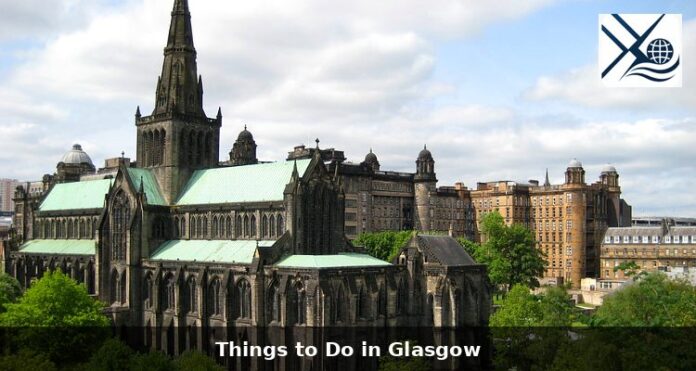
Glasgow Cathedral cuts through the later city with unusual force. Much of central Glasgow reads as nineteenth century, but the cathedral drops you into something older and more austere, Gothic in a way that feels structural rather than decorative. The stone has gravity. The vaulting does not ask for admiration; it assumes endurance.
Its setting matters almost as much as the building itself. The Necropolis rising nearby gives the area a severe silhouette, especially under low cloud, and the ground around the cathedral still suggests an earlier urban order, before commercial expansion thickened the centre. You do not need much imagination there. The historical layers are already exposed.
Inside, the lower church is especially affecting. It is dimmer, denser, less obviously monumental than the upper spaces, and better for it. Glasgow can sometimes seem all frontage and momentum. The cathedral interrupts that impression with something slower and older, a reminder that the city did not begin with trade, shipbuilding, or department stores.
Merchant City, City Chambers, and Victorian confidence on display
A short distance away, Glasgow’s commercial swagger becomes plain. Merchant City and the surrounding central streets still carry the imprint of mercantile money, civic ambition, and a period when the city wanted its buildings to project command. Done badly, that kind of architecture turns pompous. In Glasgow, it often lands with more complexity because the streets remain mixed in use and temperament.
George Square is the clearest stage for that confidence. The City Chambers dominates the square with all the expected grandeur, but its success lies in proportion and detail rather than sheer bulk. Elsewhere in the centre, old banking halls, trading buildings, arcades, and warehouses show how commerce shaped the city’s visual language. Columns, domes, pediments, carved façades—the vocabulary is unapologetically assertive.
Yet the best moments are often peripheral: a lane off a main street, an upper-storey detail above a modern chain store, a patched wall beside an elaborate frontage. Glasgow’s architectural character does not survive as a museum piece. It survives because the city keeps using it, awkwardly at times, but usefully.
Local culture sits in conversation, music, and neighbourhood habits
You can spend a day in institutions and still miss the local pulse if you do not pay attention to how people occupy the city. Glasgow’s culture is not a soft abstract quality. It comes through accent, pace, humour, football loyalties, hospitality that can turn teasing within seconds, and a deep suspicion of pretension. That attitude shapes where people gather and how places feel after dark or on wet afternoons.
Neighbourhood character matters here. The West End performs one kind of confidence; the Southside another; the city centre shifts by hour; the East End keeps its own cadence. None of these areas can be flattened into branding copy without losing what makes them legible. Glasgow is too opinionated a place for that.
Live music venues and the city’s refusal to become background noise
Music in Glasgow is not a decorative extra tacked onto the visitor economy. It is one of the clearest ways the city announces itself. The famous venues matter, of course: King Tut’s Wah Wah Hut, Barrowland Ballroom, the Old Fruitmarket, the Royal Concert Hall. Each carries a different scale, crowd logic, and history, and together they show how broad Glasgow’s listening culture remains.
Barrowland in particular has an atmosphere that newer halls cannot fake. The sprung dance floor, the lights, the sense of accumulated memory in the room—none of that feels manufactured. A gig there can seem both major and local at once. That is rare. King Tut’s, by contrast, works through compression: smaller room, closer contact, a stronger sense that something may start before it has a reputation.
What lingers, though, is not only the venue list. It is the way music fits into the city’s self-understanding. Glasgow listens seriously. It also talks seriously afterward, in bars, on pavements, on the late train home. Some places consume culture. Glasgow argues with it.
Markets, cafés, pubs, and the social texture of an ordinary day
The city becomes most readable in smaller settings, where nobody is trying to package “local life” for display. A café in Finnieston, a pub in the Southside, a food market on a weekend, a bakery queue in the West End—these places reveal the social texture better than any formal attraction can. Glasgow has style, yes, but it usually arrives through use rather than staging.
Pubs are central to that. Not every one is memorable, and that is fine. The good ones matter because they still function as proper rooms for talk rather than themed backdrops. You hear quick wit, abrupt shifts of subject, the occasional overconfident opinion delivered with total commitment. Silence is less common here than in many British cities. People tend to fill the air.
Food has sharpened too. Not in a smug way. More in the sense that neighbourhood eating now ranges widely without abandoning the city’s habits of directness and value. You can eat well in Glasgow without feeling trapped in a polished scene. That balance—good standards, low ceremony—may be the city’s most reliable cultural strength.
Public spaces and streets where the city becomes legible
Some places only make sense indoors. Glasgow needs to be walked. Parks, bridges, river routes, hill lines, and long streets do a great deal of explanatory work, especially once you start noticing how the land rises and falls. The city never feels entirely flat, either visually or socially. Views open, close, and shift again, which makes even familiar routes feel a little unstable.
Weather also changes the reading. A bright day in Glasgow can make sandstone look almost theatrical; drizzle pulls everything back into harder tones. That fluctuation is useful. It keeps the city from settling into one mood. Public space here is not always manicured, but it often feels honest, and honest places tend to stay in the memory longer.
Kelvingrove Park, the university ridge, and west-end movement
Kelvingrove Park works best not as an isolated destination but as part of a sequence. Start in the park, look up toward the university towers, cross toward the museum, follow the streets into the West End, and the city begins to explain itself through elevation, architecture, and foot traffic alone. It is one of Glasgow’s clearest spatial narratives.
The park itself has enough variety to avoid passivity. Broad paths, river curves, open lawns, steeper edges, and framed views make it useful for wandering rather than merely sitting. On a decent day it fills with students, runners, couples, children, people eating takeaway on benches, and those who seem to have come out solely to observe other people attempting leisure in Scottish weather.
The ridge above it changes the whole composition. University buildings rise with improbable confidence, and the transition from parkland to urban fabric happens quickly. That compressed shift is satisfying. You move from greenery to stone, from openness to density, without losing continuity. Many cities would overmanage a route like this. Glasgow mostly lets it happen.
The Clyde, street murals, and fragments of the modern city
The River Clyde once sat at the centre of Glasgow’s industrial identity in a way that is difficult to overstate. The river today tells a more uneven story, one of redevelopment, leftover infrastructure, cultural venues, apartment blocks, and broad walks that can feel spacious or oddly empty depending on the hour. It is not the city’s most intimate landscape, but it is an important one.
Street murals add a different layer to modern Glasgow. Some are striking, some merely competent, yet together they give parts of the centre a visual thread that counters the impersonal feel redevelopment can create. Unlike commemorative sculpture, murals often meet the street at eye level and in passing, which suits a city where people are rarely in a mood for excessive reverence.
There is something revealing in that combination: former industrial corridor, cultural reinvention, public art, modern glass, old stone nearby, weather moving across all of it. Glasgow does not resolve these elements into a smooth identity. Better that it doesn’t. Cities with too neat a story usually end up sounding like marketing.
Conclusion
Some visitors want a place to present itself cleanly. Glasgow rarely does. Its appeal comes from contrast: formal architecture beside blunt humour, serious art beside ordinary weekday noise, ecclesiastical stone not far from gig posters and takeaway wrappers, grand civic confidence offset by an almost automatic resistance to self-importance. That tension gives the city its charge.
The best reading of Things to Do in Glasgow is not as a checklist of attractions, though the major stops matter and deserve their time. It is better understood as a way of moving between institutions and street life, between designed beauty and lived texture, between what the city meant in the past and how it talks now. Glasgow rewards attention more than obedience to an itinerary.
You can admire paintings in the afternoon, trace carved façades at dusk, then end up in a crowded room where the conversation is louder than the music between sets. That feels right. The city’s character is not locked inside any single gallery, square, or landmark. It sits in the friction between them, and in the stubborn fact that Glasgow still prefers substance to performance.

